More Than a Place to Sleep: Why Furnished Housing Supersedes Hotels for Patient Recovery at the Texas Medical Center
Updated: Feb 12
When a family receives a diagnosis that leads them to the Texas Medical Center (TMC), the world seems to stop. The focus immediately narrows to clinical questions: Who is the best surgeon? What is the survival rate? How soon can we start treatment? Yet, in the whirlwind of medical consultations and treatment plans, one critical variable is often overlooked until the last minute: Where will we live while this happens?
For decades, the default answer for medical travelers was the traditional hotel. It was a simple, transactional solution: a bed for the night. However, as the complexity of post-acute care has increased and the average length of stay for specialized treatments like oncology and transplants has grown, the healthcare industry is witnessing a paradigm shift. The logistical and environmental components of a patient’s journey are now recognized as being just as critical as the clinical interventions themselves.
In a global medical epicenter like Houston, Texas, the decision regarding where to reside during treatment is no longer just about comfort; it is a complex equation involving financial sustainability, infection control, psychological stability, and caregiver support. An exhaustive analysis of the needs of medical travelers reveals that for patients at institutions like MD Anderson Cancer Center, Texas Children’s Hospital, and Houston Methodist, specialized medical housing in Houston provides a framework for healing that supersedes the capabilities of a hotel.
This comprehensive guide examines the multi-faceted advantages of furnished apartments over traditional hospitality, emphasizing why a "home away from home" is not a luxury, it is a medical necessity.
1. The Strategic Landscape of the Texas Medical Center
To understand the necessity of specialized housing, one must first understand the environment of the destination. The Texas Medical Center is not merely a collection of hospitals; it is the largest medical complex on the planet.

Navigating a City-Within-a-City
The TMC functions as a 2.1-square-mile city-within-a-city. It is home to 21 world-renowned hospitals, employs over 106,000 professionals, and sees millions of patient visits annually. While this density represents the pinnacle of clinical excellence, it presents significant navigational challenges for out-of-town patients.
Complex Infrastructure: The campus is a dense network of specialized buildings, such as the MD Anderson Main Building on Holcombe Boulevard, the Mays Clinic, and the Pickens Tower.
Connectivity: These facilities are often connected by elaborate skybridge systems and massive parking structures like the Pressler Garage.
The Commute Factor: For a patient receiving daily proton therapy or undergoing a multi-week radiation cycle, the "last mile" of the commute is grueling. Navigating Houston traffic to get from a distant suburb to the medical district can add physical and mental exhaustion to an already compromised system.
Strategic Integration vs. Mere Proximity
This environment necessitates Houston Medical Center apartments that are not merely "nearby" geographically but are strategically integrated into the hospital’s transit and support ecosystem. The ideal housing solution minimizes the friction of travel. It places the patient within 1.5 miles of their treatment center or directly on a shuttle route, turning a stressful commute into a manageable, short trip.
Key Proximity Metrics by Institution:
Institution | Key Focus | Recommended Housing Proximity | Primary Logistics Concern |
MD Anderson Cancer Center | Oncology | Within 1.5 miles or on shuttle route. | Immunocompromised safety and sterile prep areas. |
Texas Children’s Hospital | Pediatrics | High walkability or secure parking. | Caregiver rest and sibling accommodation. |
Houston Methodist | Adult Acute Care | Proximity to Main Building skybridges. | Post-surgical mobility and ADA features. |
TIRR Memorial Hermann | Rehabilitation | Proximity to Braeswood outpatient sites. | Wheelchair accessibility and lift-chair availability. |
2. Clinical Safety and Infection Control: Why Apartments are Safer
For a patient recovering from a major surgical procedure, a bone marrow transplant, or aggressive chemotherapy, the environment is the first line of defense against complications. The architectural and operational differences between hotels and furnished apartments create a significant disparity in safety outcomes, particularly regarding infection control.

The Hidden Dangers of Hotel Infrastructure
While a hotel room is technically "private," its infrastructure is communal.
High-Traffic Risks: Lobbies, elevators, and breakfast areas are high-traffic zones where patients may encounter hundreds of strangers daily.
Shared Air Systems: Hotels often utilize centralized or interconnected HVAC systems. Research suggests these can facilitate the transmission of airborne pathogens across rooms.
Nosocomial Infections: The risk of infection increases by 11% with each exposure to a new hospital roommate. While a hotel room isn't a hospital ward, the high turnover of guests presents a higher variable of risk than a dedicated short-term apartment.
Superior Environmental Control in Apartments
Furnished apartments offer a "controlled recovery space" that significantly mitigates these risks.
Independent Ventilation: Many modern Houston Medical Center apartments feature independent ventilation for each unit, reducing the risk of cross-contamination from neighboring units.
HEPA Filtration: For highly immunocompromised patients, such as those in leukemia treatment, the ability to control air quality is essential. In a private apartment, families can easily install portable HEPA filter units (capable of 12 air changes per hour) to maintain a near-sterile atmosphere, a feat difficult to achieve in a hotel room cleaned by staff who enter multiple rooms a day.
Specialized Cleaning Protocols
The standard of cleanliness required for medical recovery goes far beyond the aesthetic "refresh" of a hotel maid service.
The "Sparkling Clean" Standard: At Medical Accommodations, we adhere to a rigorous cleaning protocol that involves a two-step process: thorough cleaning to remove organic matter, followed by targeted disinfection of high-touch surfaces like doorknobs, light switches, and sink handles.
Reducing Intrusion: In a hotel, daily housekeeping means a stranger enters your sterile field every day. In a furnished apartment, the absence of daily housekeeping replaced by scheduled, professional deep cleans actually enhances safety. It limits the number of individuals entering the patient’s space, allowing the patient to rest undisturbed by the "knock" of maid service.
3. Nutritional Autonomy: The Healing Power of a Kitchen
Nutrition is the fuel of recovery. For many patients, treatment-induced side effects nausea, loss of appetite, mucositis (mouth sores), or extreme skin dryness require a carefully controlled diet and hydration regimen.
The Hotel Dining Dilemma
Relying on a hotel stay forces families into a nutritional corner.
Limited Facilities: Most hotel rooms offer only a microwave and a mini-fridge.
Restaurant Reliance: Families are forced to rely on room service or restaurant takeout. This is not only a massive financial drain (easily exceeding $100/day) but a clinical risk. Restaurant food is often high in sodium and preservatives, which can be detrimental to patients dealing with fluid retention or sensitive stomachs.
Cross-Contamination: You cannot control how food is prepared in a restaurant kitchen, posing a risk for those with neutropenia (low white blood cell count).

The Furnished Apartment Advantage
Medical lodging with full kitchens empowers caregivers to manage the patient's nutritional needs with precision.
Full-Size Appliances: With a full-size refrigerator, stove, oven, and blender, caregivers can store fresh produce and prepare specific, home-cooked meals.
Specialized Diets: Whether it’s high-calorie smoothies for a chemo patient who cannot chew solids, or low-microbial diets for transplant patients, a kitchen allows for total control.
Hydration: Proper hydration is critical. A kitchen allows for the storage of filtered water and the preparation of electrolyte-rich drinks, rather than relying on expensive bottled water from a hotel vending machine.
Nutritional Comparison:
Nutritional Factor | Hotel Accommodation | Furnished Apartment |
Food Preparation | Limited to microwave or mini-fridge. | Full-size appliances and prep surfaces. |
Cost Efficiency | Daily restaurant bills ($100+/day). | Grocery-based budget (significant savings). |
Safety | Risk of cross-contamination in kitchens. | Private, sterile food prep environment. |
Proximity to Grocers | Often limited. | Close to major grocers like Kroger and HEB. |
4. A Home-Like Atmosphere: Enhancing Psychological Well-Being
The psychological impact of the recovery environment is a well-documented factor in patient outcomes. Clinical spaces, while necessary, can induce anxiety and a sense of institutionalization. A home-like environment serves as a "restorative living space," bridging the gap between the hospital and the patient's ultimate return home.
The Psychology of Space
Avoiding "Cabin Fever": The cramped quarters of a hotel room often lead to feelings of confinement and frustration. You eat, sleep, and recover in the same 300 square feet.
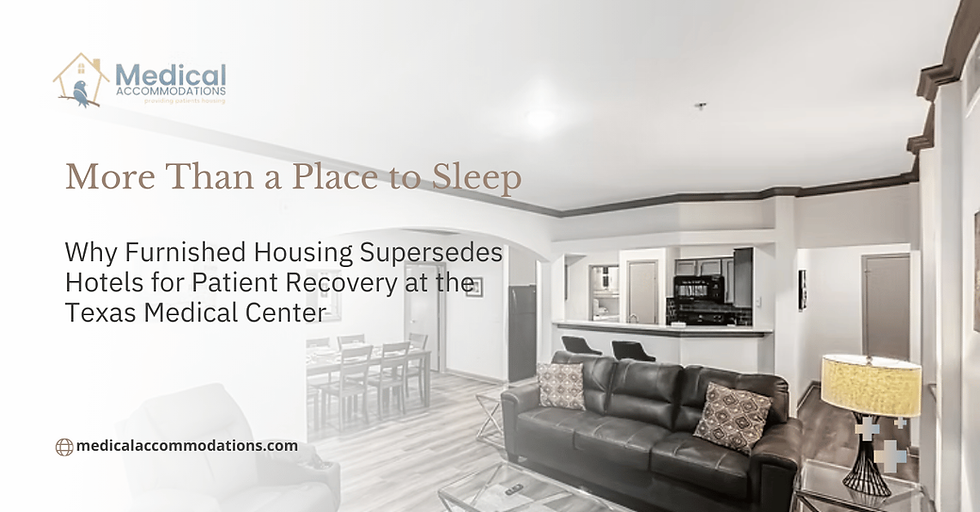
Separation of Zones: Furnished apartments provide separate living, sleeping, and dining areas. This separation allows for a sense of normalcy. The patient can rest in the bedroom while family members watch a movie or work in the living room. This simple architectural difference allows everyone to "unwind" without disturbing the patient.

Biophilic Design and Nature
Studies on biophilic design the integration of nature into living spaces suggest that viewing nature can reduce stress, blood pressure, and heart rate. Many medical housing Houston options are located near Hermann Park or the Houston Zoo. This provides patients and caregivers with opportunities for gentle outdoor walks and "connectedness" with nature, which are essential for emotional balance during a cancer journey.
Caregiver Resilience
Caregivers are the unsung heroes of the medical travel journey. Yet, in a hotel room, they get no reprieve. They sleep inches away from the patient, often waking with every movement or machine beep.
Private Space: Furnished homes with multiple bedrooms provide caregivers with their own private space. This is crucial for getting the necessary rest to remain effective support systems.
Community Support: Many medical housing complexes host families going through similar experiences. This fosters a sense of community where advice and emotional support are shared, something entirely absent in the transient atmosphere of a hotel lobby.
5. Financial Sustainability: Affordable Short-Term Solutions
Medical travel is notoriously expensive. For families facing a multi-month treatment plan, the financial burden of "hidden costs" transportation, dining, and lodging can be overwhelming. Furnished apartments provide a more cost-effective solution than hotels through a combination of lower nightly rates, tax advantages, and lifestyle savings.
The 30-Day Tax Exemption Strategy
In Texas and specifically Houston, a critical financial threshold exists for medical travelers.
The Exemption: Stays that extend beyond 30 consecutive nights are typically exempt from the 17% city and state lodging taxes.
The Math: For a stay billed at $150 per night, this exemption saves a family over $750 per month. This is money that can be redirected toward treatment, co-pays, or travel expenses.
The Difference: Hotels rarely communicate this proactively. Specialized medical housing providers, however, structure their leases specifically to capitalize on these savings for the guest.

IRS Deductions and Insurance
Families should also be aware of potential reimbursements.
IRS Publication 502: Taxpayers may deduct medical lodging expenses up to $50 per night for the patient and $50 for a companion.
Insurance Reimbursement: While inconsistent, some insurance plans (like certain Kaiser Permanente EPO plans) may reimburse lodging costs up to $100 or $150 per day.
Apartment Advantage: Specialized housing providers are accustomed to providing the detailed receipts and folios required to substantiate these claims, whereas hotel receipts can sometimes be ambiguous regarding "incidental" charges.
6. Specialized Needs: Mobility, Accessibility, and Logistics
A standard "ADA Accessible" hotel room is designed for a generic disability. A recovering medical patient, however, has specific, dynamic needs that standard hotels often fail to address.
Mobility-Friendly Features
Medical Accommodations curates residences to provide a higher level of safety and independence.
Walk-in Showers & Grab Bars: Essential for preventing falls in the bathroom, where the majority of accidents occur.
Power-Lift Recliners: For patients recovering from abdominal or thoracic surgery, using core muscles to sit up is painful or impossible. A power-lift recliner is often a "must." While renting one can cost $400/month, they are often included as complimentary amenities in our specialized suites.
Gated Access & Elevators: Ensuring a step-free path from the car to the bed is vital for patients with limited mobility.
Logistical Help: Mail and Packages
Short-term patients often need delivery of specialty medications (Adherence Pharmacy) or medical equipment. Hotels are notoriously poor at handling the security and privacy of medical mail.
Secure Delivery: Medical housing providers offer dedicated mailboxes and secure package holding, ensuring that vital medications are not lost or delayed.

7. Choosing the Right Neighborhood
Houston is vast, and the "best" place to stay depends on the family's specific needs.
The Medical Center (TMC)
Vibe: Clinical, bustling, convenient.
Best For: Patients needing daily radiation or those with mobility issues who need to be minutes from the hospital.
Trade-off: Frequent siren noise.
West University and Bellaire
Vibe: "Home away from home," suburban, affluent.
Best For: Families with children, short-term stays, and those seeking quiet. These areas feature "million-dollar homes," tree-lined streets, and top-tier safety.
Distance: 1–3 miles from TMC.
Montrose and Upper Kirby
Vibe: Bohemian, diverse, local culture.
Best For: Patients wanting a "normal" life, access to museums, and a thriving food scene.
Distance: 10–15 minutes by car.
8. Trust and Safety: The Medical Accommodations Standard
Choosing a housing provider is an act of trust. For medical patients, the stakes are far higher than for a typical traveler. At Medical Accommodations, we distinguish ourselves through a level of urgency and service specific to the healthcare industry.
Flexibility is Key: Medical treatment is rarely linear. Appointments get cancelled; surgeries get delayed. Unlike hotels or Airbnbs with rigid cancellation policies, we offer flexible rental terms. Whether it's daily, weekly, or monthly, we adjust as your clinical status changes.
No Displacement: If a guest needs to extend their stay due to a medical complication, we prioritize their stay over new bookings. You will never be "kicked out" because a tourist booked your room for the weekend.
Quality Control: Every apartment undergoes a "Quality Checked" inspection before arrival. We verify Wi-Fi speed, appliance functionality, and the presence of requested ADA equipment.

Conclusion: A Stress-Free Stay Supports Your Healing Journey
The path to recovery is often long and fraught with challenges, but the environment in which that recovery takes place should not be one of them. For families traveling to Houston, choosing comfortable recovery housing in Houston is more than a logistical decision; it is a clinical one.
By selecting a furnished apartment over a traditional hotel, you gain access to the nutritional autonomy of a full kitchen, the safety of a private residence, and the psychological comfort of a true home-like atmosphere.
At Medical Accommodations, we understand that you are not just looking for a place to sleep, you are looking for a sanctuary where you can heal. Our team is dedicated to providing patient-focused housing that is clean, secure, and strategically located near the world-class institutions of the Texas Medical Center.
Frequently Asked Questions (FAQ)
Q: Is a serviced apartment cheaper than a hotel?
A: Yes, for short-term stays. While the nightly rate might look comparable at first glance, apartments offer discounted weekly/monthly rates. When you factor in the 17% tax exemption (for 30+ days) and the savings on food and laundry, an apartment is typically 20–40% cheaper over the course of a month.
Q: What about cleaning? I like daily maid service.
A: We find that most short-term patients prefer privacy over daily interruption. However, we offer professional cleaning services on request. You get the cleanliness you need without the constant intrusion of staff.
Q: Is it worth it to rent a furnished apartment?
A: Absolutely. The ability to separate your sleeping and living areas, cook your own food, and live in a non-institutional environment directly impacts your mental health and physical resilience. It transforms a "medical trip" into a period of supported living.
Q: Why is a furnished apartment better than a hotel for medical recovery in Houston?
A: While hotels are designed for short-term convenience, they often fall short when it comes to short-term healing. The primary difference lies in the environment of recovery.
Infection Control & Safety: Hotels are high-traffic environments. You share lobbies, elevators, and often HVAC (air) systems with hundreds of transient travelers daily. In contrast, our furnished apartments offer lower-density living with independent ventilation systems and private entrances in many units. This significantly reduces your exposure to airborne pathogens, a critical factor for immunocompromised patients.
Nutritional Autonomy: In a hotel, you are often forced to rely on microwaves, room service, or restaurant takeout. This is not only expensive but risky for patients on restricted diets (e.g., low-sodium, neutropenic, or soft-food diets). Our apartments feature fully equipped kitchens with full-sized refrigerators, ovens, stoves, and dishwashers. This empowers caregivers to prepare safe, healthy, and medically compliant meals exactly when the patient needs them.
Psychological Space: Recovery is mentally taxing. Living in a single hotel room for weeks can lead to "cabin fever" and increased stress. Our apartments provide separate living and sleeping areas. This architectural separation allows a patient to rest in a dark, quiet bedroom while the caregiver watches TV, works, or decompresses in the living room. This sense of "normalcy" is a vital component of mental health during treatment.
Q: What are the best places to stay near the Texas Medical Center?
A: The "best" location is subjective and depends entirely on your specific medical and lifestyle needs. We generally categorize them into three zones:
The TMC Core (Old Braeswood / Medical Center Area): This is ideal for patients with daily appointments (like radiation or proton therapy) or those with limited mobility. Staying here means your commute is often just a 5-minute shuttle or Uber ride. The trade-off is that it is a busy, clinical environment with frequent ambulance sirens.
West University & Bellaire: These are premier residential neighborhoods located 1–3 miles from the hospitals. They are perfect for families, especially those with children, who want a "home away from home" feel. The streets are tree-lined, safe, and quiet, offering a peaceful retreat from the hospital intensity.
Montrose & Museum District: For patients who want to feel like they are living a "normal" life, these areas offer walkability to Houston’s best parks (Hermann Park), museums, and restaurants. It provides a mental escape from the illness, which can be incredibly therapeutic.
Q: Is the Houston Medical Center area safe for out-of-town visitors?
A: Yes, the Texas Medical Center and its surrounding neighborhoods are generally very safe. The TMC has its own dedicated police force and security patrols that monitor the campus 24/7. However, like any major metropolitan area, situational awareness is important. At Medical Accommodations, we add an extra layer of security to your stay. We prioritize properties that feature gated access, controlled-entry lobbies, and secure parking garages. We also vet our locations to ensure they are in well-lit, populated areas, so you can feel secure coming and going, even if your appointments run late.
Q: How can I make my short-term medical stay in Houston more comfortable?
A: The key is to shift your mindset from "visiting" to "living."
Establish a Routine: Unpack your suitcases immediately. Living out of a bag adds subconscious stress. Use the dressers and closets provided to organize your clothes and medical supplies.
Create a "Command Center": Use the desk or dining table to set up a dedicated space for medical binders, appointment calendars, and laptops. Keeping medical chaos separate from your relaxation space helps you mentally "switch off."
Digital Comforts: We provide high-speed Wi-Fi, so bring your streaming devices (Roku, Fire Stick) or log into your accounts on our smart TVs. Watching your favorite shows can provide a comforting link to your life back home.
Personalize the Space: It might seem small, but bringing a few photos of family/pets, a favorite throw blanket, or even your own pillow can instantly transform a rental into a sanctuary.
Q: What should I pack for an extended medical stay in a furnished apartment?
A: Since we provide all the furniture, linens, towels, and kitchenware, you can focus on personal comfort and medical logistics.
Clothing: Pack "adaptive" clothing shirts that button in the front or zip-up hoodies are much easier to manage with IV lines, ports, or post-surgical dressings than pullover t-shirts.
Toiletries: Hospital air and chemotherapy can be incredibly drying to the skin. Bring extra high-quality moisturizers, lip balms, and sensitive-skin soaps.
Medical Organization: Bring a dedicated notebook or planner for doctor’s instructions, along with a multi-socket extension cord (to charge phones/tablets easily from a hospital bed or recovery chair).
Entertainment: A tablet or e-reader is invaluable for long waits in waiting rooms.
Q: How do I manage mail and package deliveries during a short-term medical stay?
A: This is a common concern, especially for patients who receive specialty medications or supplies by mail. Unlike hotels, where packages can sit unattended or be refused, our housing solutions are designed for residents. Many of our properties utilize secure package locker systems (like Parcel Pending) or have 24-hour concierge desks that log and store deliveries. When booking, please inform our team if you expect critical medical shipments so we can place you in a unit with the most robust package-handling protocols.
Q: Can medical housing expenses be tax-deductible or covered by insurance?
A: This is an important financial avenue to explore.
Tax Deductions: Under IRS Publication 502, you may be able to deduct lodging expenses primarily for medical care. The current limit is generally up to $50 per night for the patient and $50 per night for a companion. We provide the detailed, itemized monthly invoices required to substantiate these claims on your tax return.
Insurance Reimbursement: While traditional health insurance rarely covers "rent," many policies (especially for transplant or cancer care) have "Travel and Lodging" benefits. Additionally, third-party organizations (like the American Cancer Society or Leukemia & Lymphoma Society) sometimes offer stipends.
Flexibility: We are experienced in working with insurance adjusters and can often bill corporations or foundations directly if your policy allows it.
Q: How to find affordable short-term housing near MD Anderson or Texas Children’s Hospital?
A: Affordability in medical travel comes from looking at the "Total Cost of Living," not just the nightly rate.
The 30-Day Rule: In Texas, any rental of 30 consecutive days or more is exempt from the ~17% Hotel Occupancy Tax. This is an automatic, massive saving. For a month-long stay, a furnished apartment is often 30-40% cheaper than a comparable hotel when you factor in this tax break.
Hidden Savings: A kitchen saves you ~$100/day in dining costs. In-unit washers and dryers save you expensive hotel laundry fees. Free parking at many of our properties saves you the $25+ daily valet fees common at hotels.
Our Approach: We specifically negotiate rates for medical terms, offering a sliding scale where the daily rate decreases significantly the longer you stay.
Q: What resources are available for family members and caregivers staying in the Houston Medical Center?
A: Caregivers are often the unsung heroes, and they are prone to burnout.
Restorative Sleep: Our multi-room apartments allow caregivers to sleep in a separate bedroom. This uninterrupted rest is crucial for maintaining the stamina needed to advocate for the patient effectively.
Remote Work Capabilities: We know life doesn't stop for a diagnosis. Our apartments include high-speed Wi-Fi and dedicated workspaces, allowing family members to continue working remotely without needing to go to a coffee shop.
Local Respite: We guide caregivers to nearby resources like the McGovern Centennial Gardens or Hermann Park, where a 20-minute walk can provide a much-needed mental reset.
Q: Are there handicap-accessible or mobility-friendly apartments in the Medical Center?
A: Absolutely. We understand that a "standard" apartment doesn't work for a post-surgical patient. We curate units specifically for accessibility.
Mobility Features: We have inventory featuring walk-in showers (no tubs to step over), elevator access, and wide doorways suitable for walkers and wheelchairs.
Equipment Rental: Through our partners, we can arrange for medical equipment such as shower chairs, toilet risers, or hospital beds to be delivered and set up in your apartment before you arrive.
Ground Floor Options: For those who want to avoid elevators entirely, we can prioritize ground-floor units with direct access.
Q: What makes 'Medical Accommodations' different from standard corporate housing?
A: Our entire business model is built around empathy and flexibility.
Medical Flexibility: Corporate housing leases are rigid. We know medical dates change, surgeries get delayed, and treatments get extended. We offer flexible lease extensions and compassionate cancellation policies that standard landlords simply do not provide.
Urgency: We operate on "hospital time." If you get discharged on a Friday at 4 PM, we work to get you housed immediately.
The "Sparkling Clean" Standard: We utilize hospital-grade cleaning protocols between guests, ensuring a level of sanitation that goes far beyond a typical "maid service."
Q: Where can I find support groups or community resources while staying in Houston for treatment?
A: You are not alone in this journey.
Hospital Resources: Institutions like MD Anderson and Texas Children's have robust Social Work departments that host daily support groups. We strongly encourage you to ask your Nurse Navigator for the monthly schedule.
Local Non-Profits: Organizations like Halo House, The Hospitality Apartments, and Target Hunger offer various forms of support.
Informal Community: One of the hidden benefits of our housing is the community. You will likely meet other families in the elevator or courtyard who are navigating similar paths. These informal connections often become deep sources of comfort and advice.
Q: The best grocery delivery and pharmacy services near the Houston Medical Center.
A: If you are too fatigued to shop, Houston has excellent delivery infrastructure.
Groceries: H-E-B is the beloved local grocer and offers curbside pickup or delivery via the H-E-B app. Kroger and Whole Foods (via Amazon Prime) also deliver directly to our apartment doors.
Pharmacies: For routine meds, CVS and Walgreens are located on nearly every major corner near the TMC.
Specialty Services: Adherence Pharmacy is a fantastic local resource that specializes in complex medical regimens. They often deliver directly to patient homes and organize pills into easy-to-use blister packs. MD Anderson and Texas Children's also have outpatient pharmacies that can courier meds to your local address.